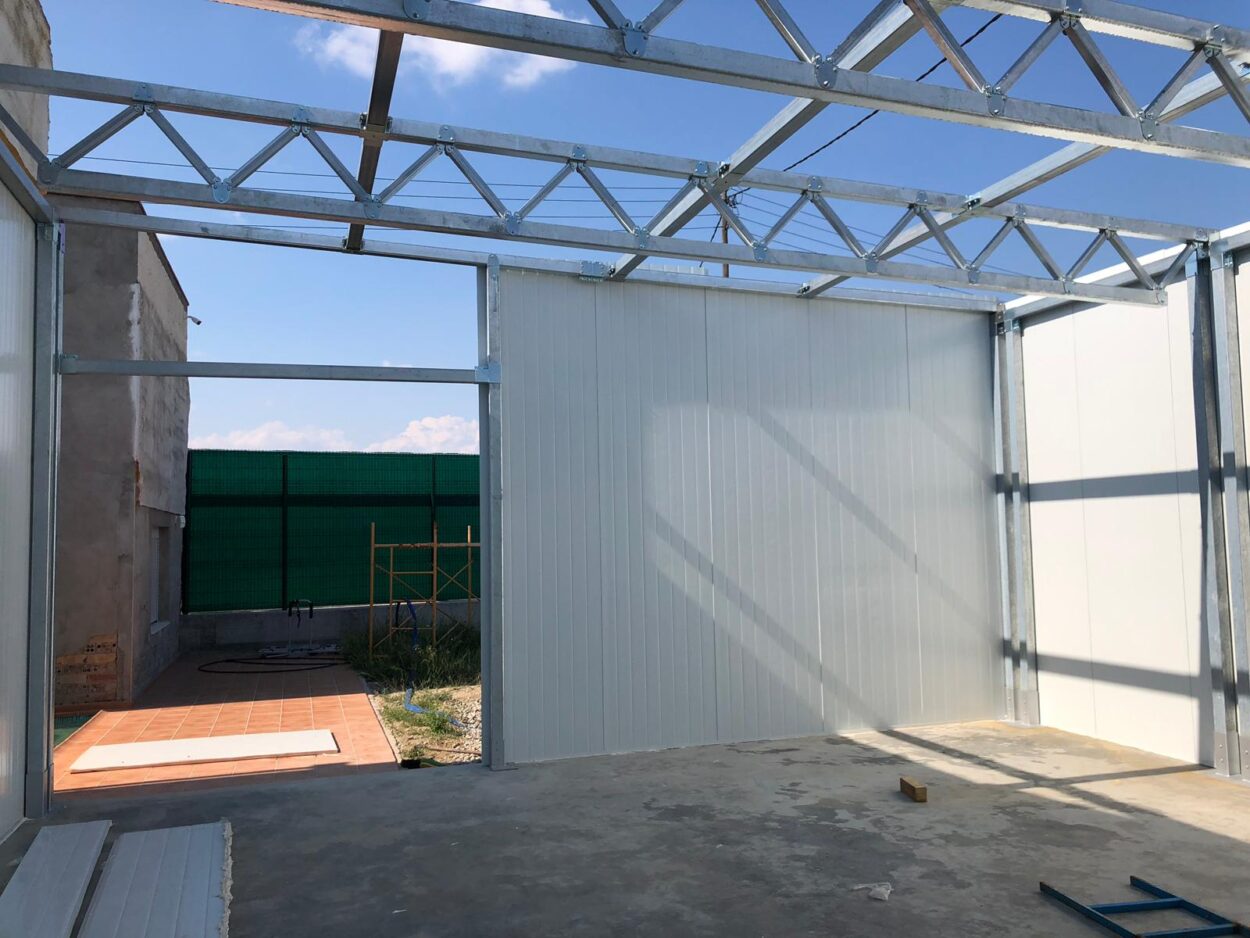
In the field of fabrication and assembly of sheet metal and profile structures, welding is often considered the default option. However, modern engineering shows that bolted joints offer superior performance in terms of accuracy, cost and versatility. The mechanical joining system allows for much tighter quality control, eliminating critical variables that depend solely on the manual expertise of the operator and replacing them with the precision of automated processes.
Efficiency Comparison: Screws vs. Welding
The transition to bolted systems is not only a logistical improvement, but also an optimization of the structural integrity of the assembly:
- Reduced operating costs: While welding is a manual process prone to human error, bolting benefits from automated processes that minimize rework and lower labor costs.
- Equivalent or superior strength: There is a myth that welding is stronger, but the strength of a high quality bolt is consistent and predictable, unlike a weld that may have porosities or invisible internal flaws.
- Maximum dimensional accuracy: Cutting and drilling machines ensure that the holes match millimetrically, allowing for much tighter tolerances in the final assembly.
- Impeccable finishes: By assembling already treated parts (galvanized or lacquered), the deterioration of the coating caused by the heat of welding in hard-to-reach nooks and crannies is avoided.
Structural performance analysis
| Technical Factor | Bolted Joint | Union Soldier |
| Quality Control | Automated and verifiable | Dependent on manual dexterity |
| Maintenance | Easily replaceable parts | Requires cutting and rewelding |
| Surface Finish | Uniform and durable | Vulnerable to corrosion at the joint |
| Flexibility | High (allows disassembly) | Null (permanent union) |
Ease of repair and replacement
One of the greatest benefits of bolted structures is their in-situ maintainability. In the event of any accidental damage, such as that caused by extreme weather events, a bolted section can be disassembled and replaced with a new part manufactured to the same precision coordinates. In a welded structure, any repair involves cutting the material, weakening the affected area and welding under field conditions, which rarely matches the quality of the original factory part.
Design optimization from source
To take full advantage of these benefits, it is essential to integrate mechanical fasteners from the initial design phase. The patented jointing system allows the components to behave like a high-precision meccano. This not only facilitates transport logistics by allowing the parts to be shipped disassembled, but also ensures that final assembly is fast, clean and without surprises. Designing with bolting in mind ensures a smarter, more sustainable structure that is ready for future modifications or extensions without the added cost of heavy machinery.
Structural safety is a priority for Starmodul. For this reason, we are committed to bolted joints in metallic structures as the best technical option.